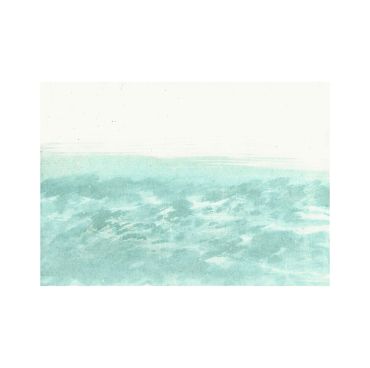
Drawing and painting have always been a part of my life. My relationship to them has grown and changed over the years—from a bubble for my own thinking and amusement, to making something that will also be seen by others. I am often puzzled by these two aspects, and think about expression, experimentation, composition, playfulness and the different methods that emerge around them.
And so, I think I arrive at a few different ways of working, which sometimes overlap. In one, I get lost in the act of drawing. I play music and draw, while thoughts and images run through my head. The drawings develop their own logic, yet remain quite open, as I draw without references in front of me. At other times, I draw from something I have seen or experienced, as a way to remember it or stay with it. I like experimenting with materials, surfaces and their interaction with the weather, simply to see what happens. I look for tools, or things that can become tools, and colours and dyes that I can find locally.
Sometimes the work also invites the visitor/viewer into a situation, where something unfolds through their interaction with it. It is somewhat premeditated, but remains gentle or suggestive rather than instructive or imposed.
_____
Thematically, my work explores fluidity, fluid positionality and non-binariness – through the prism of geopolitical and personal anxieties, as a stance against hyper-nationalism, and through gender, of course. I draw from tensions around these into my work to think about how I am, or how we are, negotiating our being, relating to each other and to the places we find ourselves in. I think about movement and mobility through thresholds and spatial negotiation as a form. Drawing from research, memory and things encountered or collected along the way, my work often takes the form of fragmented narratives, spaces and situations. Fiction often becomes a way of bringing these fragments together, allowing connections between places, objects and histories to form.